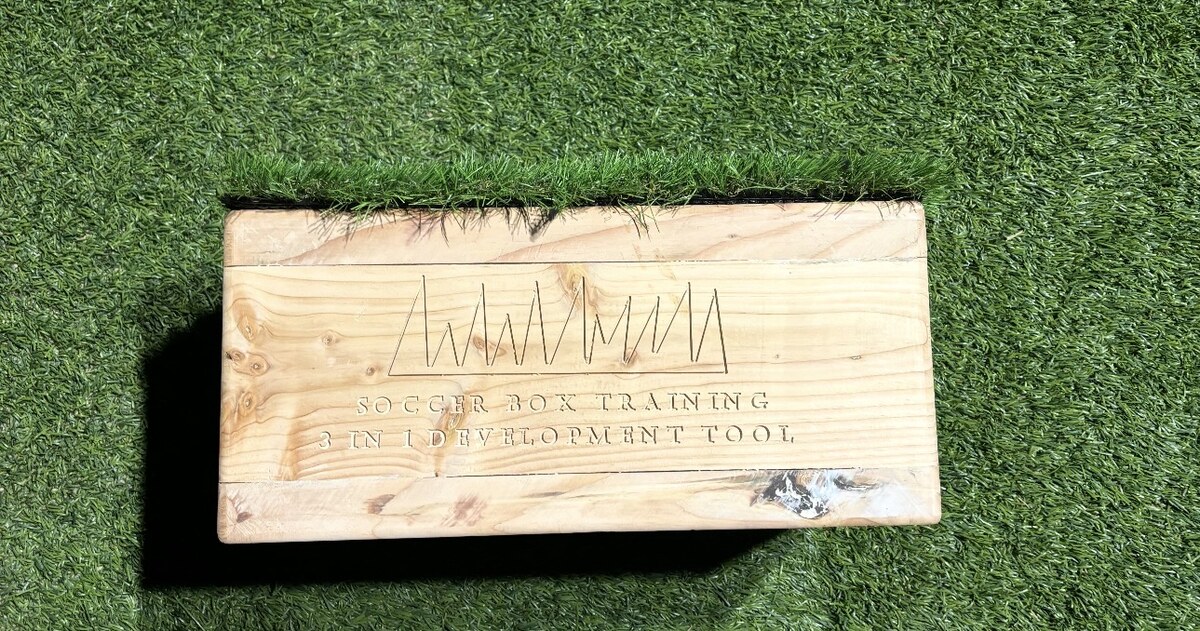
START WITH THE BOX.
One simple piece of equipment combines technical repetition with movement, balance, receiving, and coordination demands. Build plans are available by request; manufactured orders are not open yet.
SEE THE BOX AND BUILD OPTIONS ↗
SOCCERBOXES / PRACTICE AT HOME
The SoccerBox gives you a simple way to practice together. My lessons teach you what to look for, how to guide the activity, and when to adjust the challenge. Build the confidence to help your child improve—and coaching skills you can keep using as they grow.
MEMBER ACCESS
Sign in at the top right to access your saved progress and player journals.
HOW SOCCERBOXES WORKS
Parents do not need to be expert coaches to participate. The tool creates the conditions, the lessons provide direction, and reflection makes the experience worth returning to.
One simple piece of equipment combines technical repetition with movement, balance, receiving, and coordination demands. Build plans are available by request; manufactured orders are not open yet.
SEE THE BOX AND BUILD OPTIONS ↗Understand what each Box activity develops, guide your child's technical work, recognize improvements, and adjust the challenge. A four-week focus and new teaching are planned to support ongoing practice.
SEE WHAT MEMBERSHIP INCLUDES ↗Your child learns to process training and match experiences. You listen, add your own perspective, and stay connected to the journey through your parent-owned account.
HOW THE TEACHING DEVELOPS
First, I work directly with a player so you can see the movement, technique, and details I'm watching. Then I work with parents, including those who have never coached soccer, to show how to guide their own child. Later episodes show how the coaching changes with different players and skill levels, including advanced players.
I'm developing the full curriculum and filming the next episodes. The member dashboard currently contains written demonstrations, not the finished course.
ONE DIGITAL MEMBERSHIP / AN ONGOING PRACTICE
The box is where you start. Membership helps you learn to coach with it, recognize what needs adjusting, and guide your child's reflection after practice and games. A next session, a four-week focus, and new teaching help you keep returning to the work together.
EXPLORE THE MEMBERSHIP ↗ DIGITAL MEMBERSHIP IS IN DEVELOPMENTWHY I BUILT IT
When my son Jeremiah wanted to improve, we started working together. It wasn't always easy. We challenged each other, and the process tested our relationship. But pursuing something he loved, with a goal we shared, strengthened it.
I'd played professionally, so I understood the game. I built the box to simplify the technical work and make purposeful repetition easier. Now I want to share that tool and what I learned with parents who want to help but aren't sure what to do, or whether they're doing the right things.
The aim isn't to replace your child's coach or promise a professional career. It's to give you a way to participate, learn together, and build something that lasts beyond a session.
READ OUR STORY ↗THE LAB / IN-PERSON TRAINING
Choose individual or small-group player training, or a hands-on parent-and-player session. Scheduling and rates are confirmed before booking.
Individual or small-group work built around repetition, decision-making, responsibility, and an honest training standard.
Put the membership's parent-coaching method into practice together: learn to demonstrate, set a challenge, recognize progress, and decide when to step back.
THE EQUIPMENT / THE PRACTICE
Explore the design, request the build plans, or check the status of manufactured boxes. The 360° model and construction notes are below.
EPISODE 01 / FROM THE FIELD
A firsthand introduction to the Soccer Box and the thinking behind it. See where independent repetition begins.
SOCCERBOXES / INTERACTIVE DESIGN STUDIO
Explore the Soccer Box from every angle, then see how a proposed version can be built from standard lumber and plywood.
DRAG TO ROTATE / USE ARROW KEYS / 360° VIEWConceptual model of the original exterior, rotating automatically.
A homemade box built from the construction drawings. It does not include the manufactured box's professional sanding, stain, rounded-edge finish, engraved logo, or handles. Request the cut ticket and confirm cutting tolerances with your lumber shop.
The $175 manufactured SoccerBox is professionally sanded and stained, with rounded edges, an engraved logo, and handles. Ordering is not yet open. Training is a separate membership.
The manufactured SoccerBox is the professionally finished version of the training tool: sanded and stained wood, rounded edges, an engraved logo, and carrying handles. It supports movement, coordination, ball work, and purposeful practice. The digital membership teaches families how to use it.
The $175 product price is set; production capacity, shipping, delivery, and checkout remain to be confirmed. You can request build plans or follow updates in the meantime.
FOLLOW BOX AVAILABILITY UPDATES ↗SOCCERBOX FITNESS / IN DEVELOPMENT
I'm developing a way for adults to use the ball and the Soccer Box for purposeful movement, coordination, and conditioning. The program is not available yet.
THE IDEA
Parents, former players, and people new to soccer should have a place to move with the ball. I'm developing short, adaptable workouts centered on footwork, balance, rhythm, and conditioning.
CURRENT STATUSDigital workouts: in development
In-person classes: not scheduled
Enrollment and booking: not open
PROGRESSIVE VIDEO SERIES / PARENT-OWNED ACCOUNT
Each member starts with the first four-week program. Watch me work directly with a player, learn what I'm seeing, then learn how to coach your own child, even if you've never played soccer. As the series develops, you'll see how the details, coaching points, and emphasis change across player abilities, including high-level players. Journaling connects that work to your child's experience.
FREE PARENT ACCOUNTS ARE OPEN. VIDEO CURRICULUM AND PAID MEMBERSHIP ARE IN DEVELOPMENT.
YOUR TWO CORE FEATURES
Everything below is part of the planned digital membership. The physical SoccerBox is separate: see how to build one or check buying availability ↗
Learn what each activity develops, how to set up purposeful practice, what improvements to look for, and how to adjust the challenge. Use guided sessions and four-week focuses to keep work progressing.
Your free account includes written Foundations practice notes; teaching videos are still being developed.
Children learn to describe what happened, notice progress, and choose what to try next. Parents can participate through their account, with separate observations and guided questions.
Save player reflections and separate parent observations to your account. Live AI guidance is not available.
HOW TO USE THEM TOGETHER
After a session or game, use the journal to name one learning moment. Use that insight to choose the next challenge.
Free parent accounts include written Foundations notes, saved lesson progress, and separate player journals. Paid membership, live AI guidance, and full video delivery are still in development.
CREATE FREE ACCOUNT ↗THE CURRICULUM / SIX PROGRAMS
Every member starts with Program 1. Each four-week program changes the training environment and the details you learn to recognize. Jeremiah is developing the lessons and filming the series; this is the confirmed program structure, not a published course.
Get acquainted with the Box through movement and drills without a ball.
Move into box drills with the ball, building on the movement foundation.
Watch Jeremiah train a parent and a young player, age six and under.
Learn how the coaching changes with a player aged 12 and under.
Work with U15-and-older players and parents with different levels of soccer knowledge and coaching ability.
Observe Jeremiah training a professional-level player and the different details and demands involved.
Planned paid membership: $29.99/month · Starts at Program 1 · Video lessons and payment access are in development.
THE MONTHLY RHYTHM
The curriculum grows through practical lessons, a four-week focus, and responses to recurring questions from families.
Start with movement around the Box. Later programs layer in ball coordination, technique, pace, complexity, and workload.
Learn the little details, how to give a useful cue, and when to adjust difficulty or duration.
Submit questions. Jeremiah plans video responses to recurring themes from members, so the answers can help everyone, not individual DMs.
Use journaling to notice progress. Curriculum-grounded AI guidance is planned with parent controls and strict limits.
Every family begins with the first four-week program, then continues through the sequence. The member-request video program will begin when paid enrollment launches. The physical SoccerBox is separate.
PARENT COACHING / INCLUDED IN MEMBERSHIP
You'll first see me working with a player and explaining what I notice. The next phase shows parents learning to work with their own children, from setting up a session to spotting small details and choosing useful feedback. We'll then explore how those observations and coaching decisions change when working with players at different levels, including advanced players.
I am developing the detailed curriculum and filming upcoming episodes. The examples below are provisional written previews, not a finalized lesson schedule.
What the equipment does, what repetition can develop, and why the task matters.
Choose a goal, set a short work period, and make the environment safe and repeatable.
Serve, participate, vary the challenge, and notice what the player does.
Ask before instructing. Let mistakes create information and ownership.
End with a question, a journal entry, and one adjustment for the next session.
A FIRST SESSION TO TRY
Start with a simple goal. Give the child ownership of what to notice; the parent supports the environment.
Use equipment on a stable surface with suitable space and supervision. Adjust demands to the child's ability. This supports, but does not replace, games, coaches, or other training environments.
SOCCERBOXES / YOUR MEMBER HOME
Choose a player. Train with purpose. Reflect on practice or a game. Decide together what to work on next.
PROGRAM 1 / FOUR WEEKS
Begin by getting acquainted with the Box and moving around it without a ball. The second four-week program adds the ball. Later four-week programs show Jeremiah working with parents and players at different ages and levels, then a professional-level player. The exact lessons are being developed and filmed.
This is the program roadmap. Finished video lessons, secure member progress, and subscription access are not active yet.
The full curriculum and the filmed sequence are still in development. The written sessions below are demonstrations only.
Continue the next written preview below. Lesson completion tracks the parent's learning; each child's journal stays separate. Progress stays on this device; these exercises are not the finalized course.
CONTINUE YOUR WRITTEN PREVIEW
Start with controlled movement, positioning, and balance before adding a ball.
WEEK 1 / WRITTEN DEMOFOUR WEEKS / EIGHT SESSIONS
0 OF 8 COMPLETEFIND SOMETHING USEFUL
Browse the eight written lessons or search for what your child is working on. Video demonstrations are still being produced.
No lessons match that search. Try another training need.
YOUR CHILD'S SPACE / YOUR ACCOUNT
Let your child share what they noticed. You can type their answers and add your own note separately. Then explore one thoughtful question together.
The player notices what happened, explains a moment, and chooses what to try.
You manage access, read alongside your child, add context, and ask, not grade.
Structured suggestions are grounded in Jeremiah's approved journal lessons. The AI version is not yet active.
ONE ACCOUNT / MULTIPLE CHILDREN
Use Player 1, Player 2, etc. in this demo. Don't enter a child's name or identifying details. Each player's journal stays separate on this device; lesson progress belongs to the parent.
FIVE SKILLS / ONE HABIT
Start with Step 01, then move at your own pace. These written lessons are available to explore now; Jeremiah's instructional videos have not yet been filmed.
SKILL 01 / 05
TRY IT YOURSELF
A NOTE FOR PARENTS
A QUICK REFLECTION / NO PERFECT ANSWERS
Ask your child these three questions. Use their words, even if you do the typing. A single honest moment is enough.
NEW / TALK IT THROUGH ON YOUR PHONE
Take these questions to your phone and talk together after practice. Review the notes yourself before adding them to your child's journal.
Paste the formatted notes you copied or shared from your phone. You can review and change everything before saving. A phone and desktop do not automatically sync in this demo.
This player's reflections will appear here after you save one.
CURRICULUM → MEMBER REQUESTS → NEW TEACHING
The full membership will organize private member requests by theme. Jeremiah will address selected common questions in one monthly member-only note or recording. The sample below only finds related written lessons on your device; it does not submit a request.
When a parent asks how much correction is enough, the answer should change the next session. This is the kind of teaching a member request can produce: a practical answer, a linked lesson, and one thing to try, not an individual coaching thread.
Sample format only. No member messaging service is connected.Local keyword-based lesson finder only. Your question is not sent or saved. This is not an AI coaching response.
THE INTENDED RESPONSE STANDARD
FOUNDATIONS / SESSION 01 / WRITTEN DRAFT
First learn where your body is in relation to the Box. Movement and control come before adding the ball.
Written curriculum draft. Jeremiah's lesson video and final coaching cues will be added after review.
THE LEARNING OBJECTIVE
SETUP / EQUIPMENT
Warm up, repeat, and observe your next action.
Change one condition and observe what survives.
What changed, and what will you try next?
COACHING CUES
NOTE FOR PARENTS
SOCCERBOXES / A CONVERSATION, NOT A TEST
Three questions for a conversation after practice. Let your child answer in their own words. You can type what they say or dictate your own adult recap.
What did you want to make happen? What were you paying attention to?
Tell me about one moment. What surprised you? When did it become difficult or easier?
If you could do that moment again, what would you change or test?
THE PARENT CAPTURES / THE CHILD LEADS
Type your child's words or dictate your own recap using your phone's keyboard microphone. Leave anything blank that your child isn't ready to answer.
In this preview, you can dictate your own spoken recap into the longer notes field if your browser supports it. Do not record your child's voice in this demo.
Nothing is uploaded or synced. Review before saving; only this device keeps a draft.
This is a public question page and a local demo, not a secure cross-device journal. Don't type names, addresses, schools, health details, or other identifying information. Full child voice recording and automatic account sync require verified parent access, consent, retention limits, and privacy controls before launch.
JEREMIAH WHITE III / ORIGINAL FRAMEWORKS + TOOLS
Explore the Five Functions, FootyEye, Soccer's Journey, and my essays and videos. These are the frameworks and tools I've created through playing, coaching, parenting, and studying the game.
FREE TO READ / THE FIVE FUNCTIONS
Recreation, Competition, Development, Selection, and Pathway are different functions. Learn to recognize which function an environment serves and what fit means for your child. This framework is free to explore.
EXPLORE THE WORK
A tactical learning tool that helps players and parents examine situations, notice information, and think about decisions on the field.
EXPLORE FOOTYEYE ↗A living map of soccer environments and possible transitions. It helps families ask where a player can go next, rather than assuming everyone follows the same pyramid.
EXPLORE SOCCER'S JOURNEY ↗My framework for understanding Recreation, Competition, Development, Selection, and Pathway, and why fit matters more than a label.
EXPLORE FIVE FUNCTIONS ↗ESSAYS / VIDEO / SUBSTACK
My essays and videos examine youth development, parenting, the economics of soccer, trust, and the assumptions that shape decisions in the game. The writing is an open place to see the reasoning, questions, and observations behind my work.
If you're here to train with your child, the membership is where the guided Box sessions, parent coaching, and journaling live. The thinking is open to explore; the membership is the ongoing training experience.
SEE THE MEMBERSHIP ↗OPEN TOOLS AND FRAMEWORKS
Choose a tool below to explore game situations, pathways, or the purposes of soccer environments.
Tactical learning for players and parents. See situations, ask better questions, and understand the game between sessions.
OPEN FOOTYEYE ↗Read Recreation, Competition, Development, Selection, and Pathway, and examine how families navigate the handoffs between them.
READ THE FIVE FUNCTIONS ↗Explore how players move through different soccer environments, and why each transition deserves a better question.
EXPLORE SOCCER’S JOURNEY ↗JEREMIAH WHITE III / THE YOUTH SOCCER SYSTEM
A different way to understand youth soccer.
A pyramid tells you what sits above you. The map helps you understand what you need next. I built it around the jobs an environment performs, not the badge it wears.
01 / THE FUNCTIONS
Tap a function to examine what that environment should actually provide. Moving up the ladder is not the same as moving forward.
02 / THE HANDOFFS
Do you want more?
Does being tested make you want to improve?
Has improvement created differentiation?
Does what separates you survive the next level?
A handoff is not automatically a move up. It is a decision about what the player needs next.
03 / APPLY THE MAP
A league creates a platform. A club creates an environment. A coach delivers much of the experience. The player experiences the result.
| ENVIRONMENT | REC | COMP | DEV | SEL | PATH |
|---|---|---|---|---|---|
| Local Rec | |||||
| Local Travel | |||||
| National 1 | |||||
| ECNL RL | |||||
| ECNL / GA | |||||
| MLS NEXT Academy | |||||
| MLS NEXT Homegrown | |||||
| MLS Academy |
Don’t fill this in by reputation. The cells have to be earned. Ask what your player needs, what evidence supports that need, and which environment actually provides it.
04 / READ THE SERIES
Jeremiah's original nine-part explanation. Browse each slide or open it at full size.
THE ORIGINAL FRAMEWORK
Five layers. Four handoffs. One money flow. The layers can live inside one club or spread across five. What matters is what happens at the seams.
VIEW THE FULL SYSTEM GRAPHIC ↗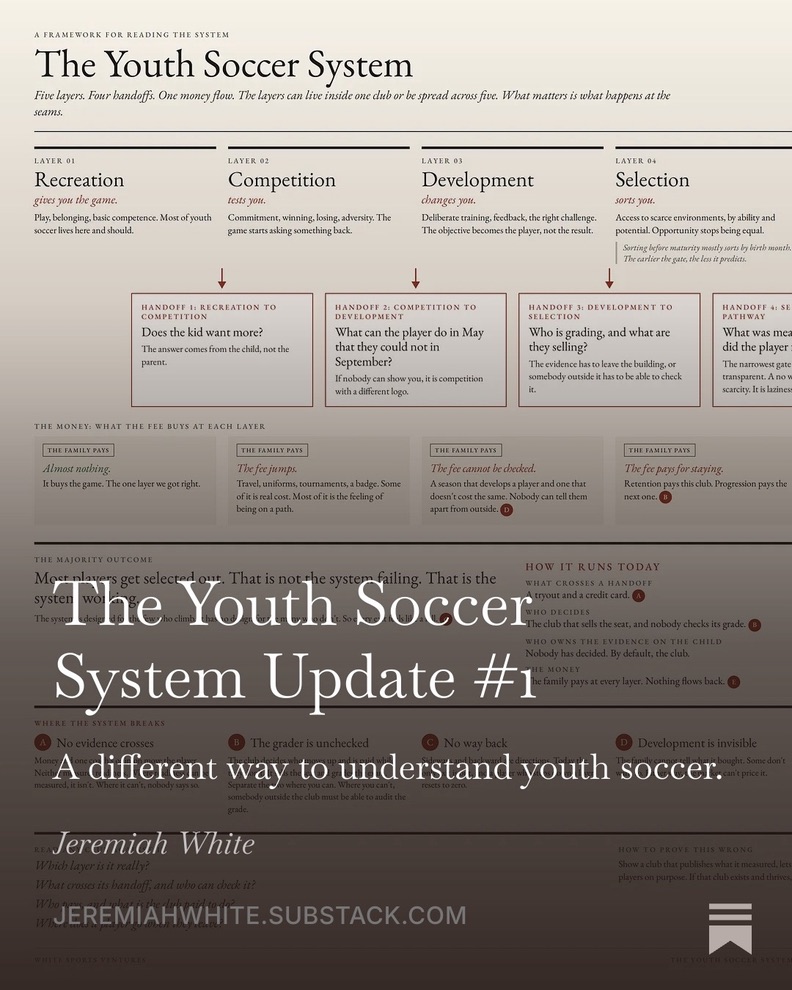
ESSAYS + VIDEO / SUBSTACK
Open my essays and videos on youth development, parenting, the economics of soccer, and the decisions that shape the game.
OPEN MY SUBSTACK ↗WHAT I WRITE ABOUT
ABOUT / JEREMIAH WHITE III
My background, the story of training my son, and how the SoccerBox came to exist.

THE EXPERIENCE
I played professionally across seven countries and represented the United States men's national team. But working with my son changed how I thought about development. We trained together, challenged each other, and built a stronger relationship through a shared goal.
I created the SoccerBox to simplify demanding technical work. I'm sharing what I learned so parents can take part in their child's development, even if they don't arrive knowing how to coach.
The details matter. What I notice, what I say, and what I ask of a player change with the player's experience and ability. That is the knowledge I want to make useful to families.
EXPLORE THE FIVE FUNCTIONS ↗THE LEAP / A FATHER'S STORY
At 9 years old, my son Jeremiah was intramural. By 14, he was at Red Bull and starting for the U.S. U15 National Team. That leap didn't happen by accident, and it didn't happen the way most people think development works.
Jeremiah was young when he got to watch me play professionally. We lived in Denmark (AGF Aarhus), Saudi Arabia (Al Ettifaq), Poland (GKS Bełchatów), and eventually came back to the States when I joined the New England Revolution.
Being around the game that early, he caught the itch almost by default. But at that age, he was still just a kid, silly, good-hearted, full of personality. A little gangly. A little Bambi.
When we settled back in the States, he wanted to play, so I put him on a local team. His first year, he didn't make the travel roster and played intramural instead. Honestly, it was a good thing.
He was with friends, part of a community, and he was happy. He stayed intramural for about two years.
By U-10, he made the travel team but he was inconsistent. He had moments, but he wasn't yet a difference-maker, and in tough games he didn't get much time. The coaches weren't rotating for the sake of it. They were making decisions based on who gave them the best chance to compete, and I respected that.
He needed to feel that. He needed to understand that being on a roster and earning minutes are two very different things.
When we talked about it, the gap was clear: it wasn't talent. It was the work outside of practice. The kids playing the most were putting in time on their own. He wasn't. So he asked me to train him.
I said yes, but I had to be careful about how I approached it. I didn't want to bring a harsh pro mentality into our relationship. He was still a sweet kid figuring out who he was, and I didn't want to damage that or turn something he loved into something he dreaded. So I started with something simple and I used it as a test. Not of skill, but of attitude.
Our early sessions were built around one challenge: take the ball from me. Over and over. Sometimes he couldn't win it once. The point wasn't to teach a move. I was watching for his willingness to stay in the fight, to keep going when he wasn't winning.
Then we flipped it: now he had to keep the ball from me. Real resistance. I paid attention to how he responded when he lost it. Did he shrug it off, or did it bother him? Did he want it badly enough to fight back?
Once losing the ball actually bothered him, once keeping it genuinely mattered to him, I knew we had something to build on.
The first requirement wasn't technical. It was consistency. I needed to know he wouldn't start and quit after three weeks. A few months in, it was clear he was committed. That's when the real work began.
He was behind technically. Not because he couldn't learn, but because foundational things had never been trained. I needed a way to accelerate development without turning every session into a grind.
That's where my background helped. I'm systems-oriented, and I'd spent years thinking in terms of problem-solving on the field. I realized we needed exercises that combined multiple developmental needs at once: technique, balance, movement patterns, first touch, passing, so we could compress real progress into a smaller window of time.
That's how I built the box.
The box is simple in design: roughly shoulder-width, about the height of a soccer ball, turf on top. But what I built around it was a full curriculum: specific movement and balance patterns, technical repetitions, passing and first-touch sequences that mimicked real game situations. The variations were almost endless, and every one of them was tied to something that would show up in a match.
We did it for hours. And he improved fast. Really fast.
Within a few months, he went from a third-tier travel environment to getting called into the Union Juniors. People who saw it were surprised. I wasn't. The box worked because it was soccer-specific.
People don't realize that when you pass a ball, you have to lift your foot to the exact height of the ball's center. Ladder drills can build general coordination, but they don't train the specific mechanics and muscle memory of passing, receiving, and moving in soccer. The box did. In terms of efficiency, it gave us more real return than almost anything else we could have done.
I also built a small turf field in our backyard with goals so we always had a reliable place to work. That was a little extreme, I'll admit, but it removed every excuse. No facility? Doesn't matter. It's right outside.
EXPLORE THE SOCCERBOXES DESIGN ↗The second accelerator was environment. At the time, I was coaching an older youth team, and I started bringing Jeremiah into sessions. He'd join rondos and possession work, anything that forced him to think faster, play cleaner, and adjust to a pace he wasn't ready for yet.
Playing up did what playing up always does: it compressed his development on the mental side the same way the box compressed it on the technical side.
Around that same period, I noticed something else: his engine.
On conditioning days with the older team, he just didn't fade. I kept testing it. It kept showing up. In elementary school, on Olympic Day, he ran the 100m and 400m against middle school kids and won the 400m. Against older kids.
That kind of endurance, at that age, is not normal. And it became an asset we could always lean on. If you can consistently out-run and out-work people at a high level, that becomes a superpower over time.
His first year in the Union Juniors, he didn't make the Union Academy. He was disappointed. But I reminded him how far he'd come, and how quickly, and why. The rate of growth mattered more than any single result. We had a process. He had the work ethic. The disappointment became fuel.
He joined a strong club team made up of players who'd been cut from the Union. Heavy tournament schedule. Good development environment. From there, he moved to the Ukrainian Nationals and played a year up, which gave him another real challenge level.
I coached him during that stretch and put him in midfield deliberately to force touches, decision-making, spacing, distribution, and awareness all at once.
That team eventually went to nationals, and it was an unusually talented group. One of his teammates, now at Anderlecht, was on that squad. Jeremiah is now at Legia Warsaw. His teammate went on to represent Belgium. Jeremiah went on to represent the United States. For that age group, in that environment, it was a rare concentration of players.
After that, Jeremiah moved to Red Bull. He was U14 but trained with U15s, spent time with U17s, and was eventually exposed to U23-level competition. He was consistently playing up, established himself as a top prospect, and earned his first U.S. Youth National Team call-up around 14 or 15.
I watched him play in that first international tournament vs Portugal, Italy, Belgium, Slovenia. I thought about where we started. A 9-year-old in intramural, a little Bambi who couldn't win a tackle off me, training in the backyard on a box I built myself.
After Red Bull, he returned to the Union and played with the U17s, winning the GA Cup with a talented group. From there, he went to Carolina Core, trained in an environment that included Eddie Pope, and continued to develop. Eventually, he signed and earned a move to Legia Warsaw, where he plays today.
At 9, intramural. At 10, local travel. At 14, Red Bull and U.S. Youth National Team.
The biggest difference-maker was the box, because it compressed development.
It trained technical patterns, balance, mechanics, and coordination in a way that transferred directly to what the game actually demands. Combined with training in older environments and a kid who refused to stop competing, it changed what was possible.
SOCCERBOXES / INFORMATION USE
How we use information from plan requests and parent accounts.
A free parent account stores your email, first name or nickname, numbered player spaces, lesson completion, and journal entries with separate parent observations. Accounts must be managed by an adult. We do not ask for children’s names or birthdays.
Vercel hosts the website, Supabase provides account authentication and member storage, and Resend delivers account confirmation and password-reset emails. Account emails are separate from optional marketing. Member records are restricted to the signed-in parent account; numbered player spaces within a household share that parent’s access.
You can delete individual reflections in your journal. To request removal of your account and its saved member records, email jeremiah@whitesportventures.com from your account address. We may need to verify the request. Avoid identifying or sensitive information about children or other people in journal entries.
We request an adult's name, email, city/region, soccer club association, experience with soccer, and goals for working with their child. We also ask you to confirm that you follow @jeremiahwhiteiii on both Instagram and TikTok.
We use this information to provide access to the protected construction files, understand the needs of families interested in SoccerBoxes, prevent repeated automated requests, and follow up about the request. Optional marketing messages are sent only if you separately opt in.
Do not submit your child's full name, exact birth date, home address, school, health information, or other identifying details. We ask for city/region, not a street address. We do not independently verify your social-media follows.
Form submissions are stored in a protected database, visible in the owner-only administration view. Download access tokens expire after seven days. To ask about or request removal of information you submitted, email jeremiah@whitesportventures.com.
Access to the plans is separate from the digital parent-coaching membership. The 360° design preview remains public.
BACK TO SOCCERBOXES ↗